
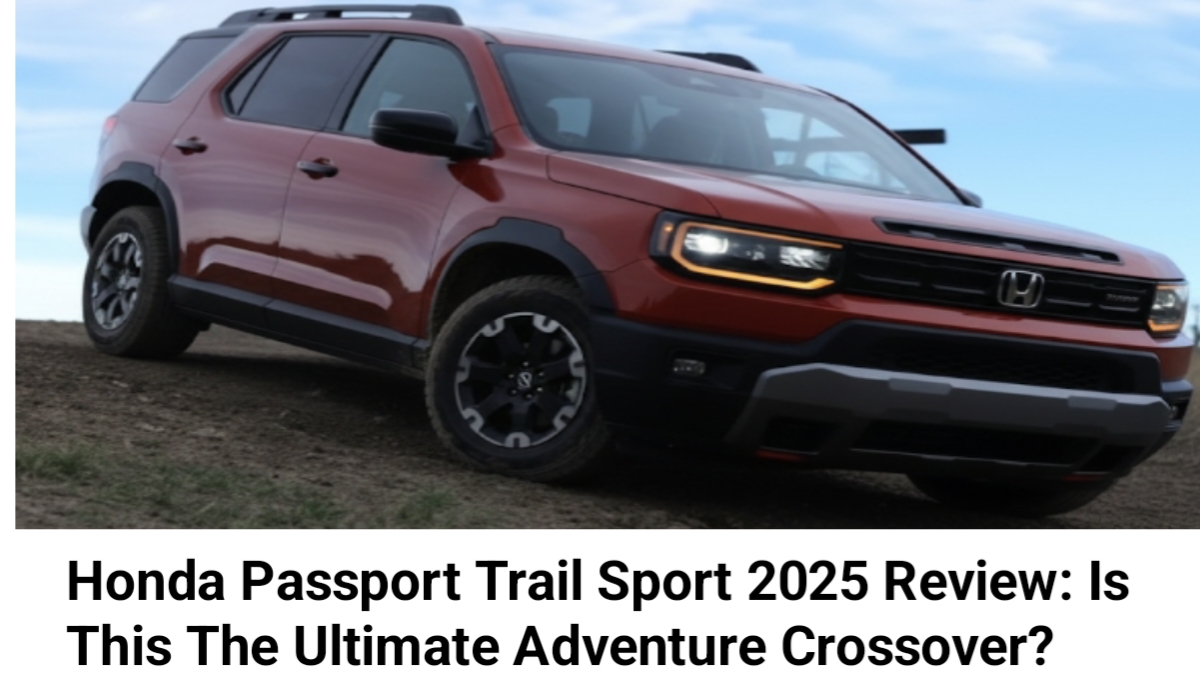
Unpacking the Passport Trail Sport’s Off-Road DNA
Before hitting the trails, it’s crucial to understand what sets the Trail Sport apart from the standard Passport. This isn’t just a package of aesthetic add-ons; Honda has made tangible upgrades aimed at improving off-road performance.
IVTM-4 All-Wheel Drive
The heart of the Passport’s capability is its intelligent all-wheel-drive system. This sophisticated system does more than just send power front to back; it can actively vector torque left and right across the rear axle, a critical feature for traction when wheels are lifted or on slippery surfaces.
Drive Modes
The Trail Sport features selectable drive modes, including Normal, Snow, Sand, and a dedicated Trail mode. These modes alter the throttle response, transmission shift points, and, most importantly, the behavior of the AWD and traction control systems to better suit the terrain.
Skid Plates
Unlike many crossovers that use flimsy plastic covers, the Passport Trail Sport comes equipped with a genuine metal skid plate protecting the engine oil pan, along with additional steel skids guarding the fuel tank.
Honda Performance Design Rock Rails
These integrated side steps serve a dual purpose, providing a step for entry and exit while also offering protection to the rocker panels from trail obstacles.
Recovery Points
Up front, the vehicle features bright orange-painted recovery points, a clear indication that Honda expects owners to use them. In the rear, a standard Class 2 hitch receiver can also serve as a recovery point with the appropriate shackle.
The Ultimate AWD Test: Conquering the Slip Test Gauntlet
To scientifically evaluate the IVTM-4 system’s effectiveness, we began with a series of “slip tests.” These tests use specialized rollers to simulate various stuck scenarios, forcing the AWD system to react and find traction.
Front Wheel Slip Test
| Test Scenario | Both front wheels are spinning freely on rollers, requiring the rear axle to engage to move the vehicle. |
|---|---|
| Mode Used | Normal |
| Result | The system performed flawlessly. With minimal throttle input, the front wheels slipped for a split second before the rear axle engaged almost instantly, pulling the vehicle forward smoothly and without drama. A perfect start. |
Diagonal Slip Test
| Test Scenario | The front-left and rear-right wheels are stuck, a common scenario when “teeter-tottering” on a snowy curb or an off-camber trail obstacle. |
|---|---|
| Mode Used | Normal |
| Result | Once again, the Passport made it look easy. With a light throttle application, the system detected the slip and distributed power to the wheels with grip, pulling the vehicle off the rollers with almost no hesitation. This demonstrated excellent everyday competence for slippery road conditions. |
The Brutal Three-Wheel Slip Test
This is where many front-wheel-drive-based crossovers meet their match. In this test, three wheels are on rollers—both rears and the front-left—leaving only the front-right wheel on solid ground.
| Test Scenario | Only the front-right wheel has traction. The AWD system must send power to the rear and then vector it to the single gripping wheel. |
|---|---|
| Mode Used | Normal → Trail |
| Result | Normal Mode: The system struggled. The free-spinning wheels whirred, but the vehicle couldn’t muster enough torque to the single gripping wheel to get unstuck.Trail Mode: The difference was immediate. Engaging Trail mode prompted the traction control to work aggressively, applying brake pressure to the spinning wheels. After a moment of thinking, a surge of torque was sent to the front-right wheel, causing the vehicle to pivot and shimmy its way off the rollers. It was a clear win, but it highlighted the critical importance of selecting the correct drive mode. |
The Final Boss: Rear Axle Torque Vectoring Test
The most demanding test isolates both front wheels on rollers, leaving only the rear wheels for propulsion. This test specifically challenges the rear differential’s ability to vector torque side-to-side.
| Test Scenario | Only the rear wheels have traction. The system must not only engage the rear axle but also send adequate power to the individual rear wheel with the most grip. |
|---|---|
| Mode Used | Normal → Various Modes |
| Result | Normal Mode: The system attempted to find a solution, with some wheel spin and rocking, but it could not free itself.Sand & Snow Modes: Surprisingly, these modes did not offer a significant improvement in rear torque vectoring for this specific scenario.Trail Mode: Returning to Trail mode proved to be the key. After a considerable amount of wheel spin and system calculation, the clutches in the rear differential finally engaged with enough force to crawl the vehicle forward. It was a hard-fought victory, requiring patience and a heavy foot, but it succeeded where the vast majority of its competitors would fail outright. |
From the Test Rig to the Dirt: Real-World Trail Performance
Controlled tests are one thing, but real trails are the ultimate proving ground. We took the Passport Trail Sport to a dedicated off-road park to see how its specs and systems translated to genuine terrain.
Tackling the Trenches Course
This course features a series of offset holes and mounds designed to lift wheels and challenge suspension articulation.
- In Normal Mode: The vehicle managed to get through, but it required significant throttle input and resulted in considerable wheel spin. It felt less controlled, relying more on momentum than sophisticated torque management.
- In Trail Mode: The transformation was dramatic. The same course was tackled with far more control and less drama. The throttle felt more linear, and you could distinctly feel the brake-based traction control system working to redistribute power, allowing the vehicle to crawl up and over obstacles with gentle throttle application. This is the mode for serious off-pavement travel, emphasizing control and minimizing damage to the vehicle and the trail.
Navigating Boulder Boulevard
A rock course presents a different challenge: ground clearance. With approximately 8.1 inches of clearance, the Passport Trail Sport is respectable for its class but not in the same league as a body-on-frame SUV. However, with careful line selection and the confidence provided by the underbody skid plates, the Passport carefully and steadily picked its way through the obstacle course. The torquey V6 engine and conventional automatic transmission provided smooth, predictable power delivery, which is essential for precise rock crawling.
Underbody Examination: A Closer Look at the Hardware

Putting the Passport on a lift revealed the details of its off-road preparation.
The Good
- The aforementioned metal engine and fuel tank skid plates are legit.
- The orange recovery points are robust and easily accessible.
- The HPD rock rails are well-integrated.
The Concerning
- Some areas, particularly in the center of the vehicle, are protected by a felt-like material that may not hold up to serious abuse.
- The rear differential and exhaust components are somewhat exposed and could be vulnerable on more extreme trails.
The Verdict: Is the 2025 Honda Passport Trail Sport Legit?
After this intensive first look, the answer is a resounding yes, with important context.
The 2025 Honda Passport Trail Sport is not a Jeep Wrangler or a Ford Bronco. It does not have a low-range transfer case or massive suspension travel. However, it was never intended to be that. What it is is arguably the most capable, trail-ready vehicle in the mainstream, front-wheel-drive-based crossover segment.
Its key strength is the highly intelligent IVTM-4 all-wheel-drive system. When paired with the dedicated Trail mode, it becomes a surprisingly competent partner for forest service roads, moderate off-road trails, and severe weather conditions. The inclusion of genuine skid plates and recovery points shows that Honda’s commitment is more than just skin-deep.
The Bottom Line
If your adventures involve daily commuting punctuated by weekends exploring campgrounds, mountain bike trails, and ski resorts, the Passport Trail Sport is an exceptional tool for the job. It offers 90% of the off-road capability most people will ever need while delivering the comfort, refinement, and reliability Honda is known for. It successfully bridges the gap between a mundane crossover and a dedicated off-roader, making it a compelling and highly practical choice for the modern adventurer.
Our long-term test has only just begun. Over the coming months, we’ll be putting it through varied conditions and seeking out even more challenging terrain to see how it holds up. Stay tuned for more.
https://techscopehub.in/ram-2500-hd/

Md Imran Rahimi is the founder and main author of TechScopeHub.in. He is passionate about technology, gadgets, and automobiles, and loves to share simple yet valuable insights with readers. With a focus on honest reviews and clear comparisons, Imran’s goal is to make technology easy and useful for everyone.”